

When something goes wrong in a relationship, the most natural question is usually: what is the other person doing, and how do I get them to do it differently?
It is a reasonable instinct. Relationships involve two or more people, and when something is not working, the other person is the most visible part of the problem. However, starting every relational difficulty from the question of how to change someone else often leads nowhere particularly useful, because it begins from the one variable you have the least direct influence over.
A different starting point, and the one this article explores, is a simpler but harder question: how am I showing up? Building healthy relationships does not begin with finding the right person or learning how to manage difficult ones. It begins with a clearer, more honest understanding of how you show up to every connection in your life.
This is not a suggestion that relationship problems are always your fault, or that self-improvement alone can heal every difficult dynamic. Healthy relationships require mutual respect, honesty, compatible values, and a shared willingness to work through difficulty. Sometimes the recognition that a particular relationship is not serving either person is the most honest conclusion available.
What does change when you develop greater self-awareness is the quality of foundation you bring. Knowing your own patterns, your fears, your needs, and your reactivity makes it possible to show up with more presence, more honesty, and more genuine care for the people you are with. That, in turn, creates the conditions in which healthy relationships can actually develop.
What Makes a Relationship Healthy?
Healthy relationships require more than affection. They depend on mutual respect, honest communication, emotional awareness, clear limits, trust, and a willingness to understand each other. These qualities develop through consistent practice rather than through a single good conversation or a peak moment of connection.
Most people have experienced both: the warmth and ease of a genuinely good relationship, and the grinding friction of a difficult one. The difference is rarely just a matter of chemistry or compatibility, though both of those matter. More often it comes down to specific capacities that can actually be developed over time.

The Qualities That Hold Relationships Together
Mutual respect means treating another person as someone whose experience, needs, and perspective deserve consideration, even when you disagree. Emotional safety means both people can speak honestly without fearing contempt, ridicule, or retaliation. Honest communication means saying what is actually true rather than what seems safest or most likely to produce a particular response.
Limits are the way people communicate what they need and what they will not accept. They are not walls designed to keep people out. Instead, they are expressions of self-knowledge that make genuine closeness possible, because closeness built on suppressed needs or unspoken resentment tends to collapse under its own weight.
Accountability means taking responsibility for your own contribution to a problem rather than defaulting to blame. Curiosity means staying genuinely interested in another person’s experience rather than assuming you already know what they think or feel. The capacity to repair conflict, to return to connection after rupture without either person needing to have been entirely right, is one of the most practically important relationship skills there is.
🗲 THE KEY INSIGHT
Healthy relationships are not the absence of conflict or difficulty. They are built from specific capacities that can be practiced and developed over time.
Why Do Healthy Relationships Start With You?
The relationship you have with yourself is not separate from the relationships you have with other people. It is the foundation they rest on.
When fear, insecurity, and unexamined reactivity operate outside your awareness, they do not disappear from your relationships. They simply work without your knowledge or deliberate participation. Ambiguous messages get interpreted through the lens of your particular fears. Patterns that remind you of older hurts trigger reactions that have more to do with history than with the present situation. And when you seek things from other people that can only come from within yourself, the relationship bears a weight it was never designed to carry.

Physical Sensitivity as a Strength
Many relational difficulties trace back to some version of fear. The fear of rejection, of not being enough, of being controlled, of being abandoned, of being seen too clearly, or not clearly enough. These fears are not character flaws. They are usually the product of real experiences, often accumulated over time, that have left particular sensitivities in their wake.
The difficulty is not the fear itself. The problem arises when fear operates entirely outside awareness, driving behavior in ways that feel natural in the moment but create distance, conflict, or disconnection over time. Someone who fears abandonment may become controlling or clingy in ways that eventually push people away. Someone who fears being overwhelmed may keep others at a carefully managed distance that looks like independence but functions as isolation.
Insecurity can produce the need for constant reassurance, which places an unsustainable demand on a partner or friend. Jealousy can lead to behavior that actually erodes the trust it was trying to protect. The need for external validation can make it difficult to hear honest feedback, because honest feedback feels like confirmation of the underlying fear rather than useful information.
Reactivity vs Response
One of the most practically significant ways our inner world affects our relationships is through reactivity: the tendency to respond from a state of emotional activation rather than from a settled, considered place. When we are reactive, we are usually responding to something that feels like a threat, even when no threat was intended.
Someone who is reactive interprets ambiguity negatively by default. A slow reply becomes evidence of indifference, a partner’s need for space becomes evidence of withdrawal, and a disagreement becomes evidence of contempt. The reactive state is not lying, exactly: it is reporting its own experience accurately. However, it is not seeing the other person clearly. It is seeing a story about the other person generated by its own fears.
Developing the capacity to respond rather than simply react does not mean suppressing emotion or pretending everything is fine. It means creating enough inner space to notice what is happening before immediately acting on it. That space is where genuine choice lives.
The Life Ki-do Perspective on Healthy Relationships
In the video below, Jonathan, the founder of Life Ki-do, explores why healthy relationships begin with the relationship we have with ourselves. He describes the central Life Ki-do framework for building healthy relationships, explains why the journey begins internally, and introduces the concept of the Inner Spark as the foundation from which genuine connection with others becomes possible.
The perspective the video describes is not a prescription for becoming self-absorbed in the name of self-improvement. It is, if anything, the opposite. People who are deeply tangled in their own unexamined fears and needs tend to have a much harder time genuinely seeing the people in front of them. Developing a clearer relationship with yourself is what makes you more available to others, not less.
The Inner Spark: What You Already Have
One of the central ideas in the Life Ki-do approach to personal development is that the qualities most important for healthy connection are not things that need to be acquired from somewhere outside. They are already present within every person. The work is not to obtain them but to learn to access and live from them more consistently.
This is what Life Ki-do refers to as the Inner Spark: the deepest place within a person, the source of their genuine strength and presence, which exists beneath the layer of accumulated fears, insecurities, and reactive patterns.
Different people connect with this place in different ways. For some it is through meditation or prayer. For others, time in nature, creative work, movement, being with animals, or extended silence serves the same purpose. The specific practice matters less than the result: a reliable connection with a place inside that is not destabilized by the noise of everyday emotional and mental activity.
From that place, the qualities needed for healthy relationships become more available. Presence, which is the capacity to actually be with another person rather than somewhere else in your mind. Genuine curiosity, rather than the projection of your own assumptions onto their experience. Patience. The ability to hear something difficult without immediately becoming defensive.
None of this requires achieving a state of permanent peace or freedom from all difficulty. It requires developing enough inner groundedness that difficult things can be worked with rather than simply acted out.
If you want to explore practical ways to develop this deeper sense of presence and connection, meditation can be a powerful place to begin. It offers a simple way to slow down, become more aware of your inner experience, and reconnect with the steadier part of yourself beneath the noise. Explore Life Ki-do’s Meditation Flow to discover practices that can help you develop this connection in everyday life.
How Does Self-Awareness Improve Relationships?
Self-awareness in relationships does not primarily mean thinking about yourself more. It means developing the capacity to notice what is happening in your inner world, specifically in the moment when you are with another person or navigating a relational difficulty.
Several questions can help orient this kind of noticing: What am I actually feeling? What might I be assuming, and is the assumption accurate? Where is fear showing up, and what is it telling me? And am I responding, or simply reacting?
Useful Questions for Relational Self-Awareness
What am I actually feeling right now? Not the story about why I feel it, or what it means about the other person, but the feeling itself. Naming a feeling, even privately, can reduce its intensity and create a little more space for thoughtful response.
What am I assuming? When we fill in gaps in understanding with assumptions, we are usually drawing on our own history. Noticing that an assumption has been made does not mean dismissing it, but it opens the possibility that there is a different, equally valid interpretation of the same situation.

Notice what you are afraid of. Fear is often the engine underneath reactivity. Naming the specific fear makes it less automatic. I am afraid this means they are losing interest in me is more useful than simply acting from that fear without knowing it is there.
Do I know what I actually need? Unspoken needs produce resentment more reliably than almost anything else in relationships. Knowing what you need is the first step toward communicating it.
Am I responding or reacting? A simple check: does this feel like a considered response, or like something that has already happened before I chose it?
These questions are not a therapy protocol or a checklist to run through before every conversation. They are a way of cultivating an ongoing habit of noticing, which builds over time into something that happens more naturally and with less deliberate effort.
The Difference Between Introspection and Rumination
One important distinction: self-awareness in the sense meant here is not the same as rumination. Rumination is the mental loop where the same thoughts, worries, and grievances circle without resolution. It looks like reflection but does not produce the kind of clarity that changes anything.
Genuine self-awareness tends to move toward some form of resolution, even if that resolution is simply: I notice I am afraid, and I am going to take a breath before I say anything. It is not the absence of difficult thoughts and feelings. It is the development of a slightly wider relationship to them, where you observe without being entirely defined by what you observe.
What Does Empathy Look Like in a Healthy Relationship?
Empathy is one of the most frequently discussed and most frequently misunderstood qualities in healthy relationships. It does not mean agreeing with everything another person says. It does not mean absorbing their emotional state and forgetting your own. And it does not mean setting aside your own needs entirely in service of theirs.
Empathy means making a genuine effort to understand what another person is experiencing from the inside, not from the outside looking in and projecting your own assumptions onto them.

What Empathy Actually Requires
The question that gets closest to this is a simple one: what might it feel like to be this person right now, given what I know about their history, their situation, and what they are telling me?
Note the word might. Genuine empathy holds its conclusions lightly. It recognizes that you cannot fully know what another person is experiencing, and that the attempt to understand matters more than certainty that you have arrived at the right answer. It involves curiosity rather than confidence.
This kind of perspective-taking is much harder to do when you are activated, when your own fears and needs are running loudly in the background. This is one of the practical reasons why developing a clearer relationship with your own inner world improves your capacity for empathy with others. When you are less consumed by your own unexamined material, you become more available to genuinely see the person in front of you.
Maintaining Your Own Center
Empathy without a grounded center can become a form of losing yourself. Some people, particularly those with high emotional sensitivity, find it difficult to distinguish between understanding another person’s distress and becoming distressed themselves. The emotions of the room become their emotions, often without any clear awareness that this exchange has taken place.
This is where the development of inner grounding becomes directly relevant to empathy. It allows you to be fully present with someone else’s difficulty without being swept away by it. You can care deeply about what someone is going through and still maintain the steadiness needed to actually be useful to them.
My Shoes, Your Shoes, Our Shoes: A Practical Framework
One of the most practically useful frameworks in the Life Ki-do approach to relationships is deceptively simple. It organizes the relational process into three perspectives, each of which requires genuine attention and each of which is incomplete without the others.
When Social Sensitivity Becomes Overwhelming
The My Shoes perspective begins with honest self-examination. Before moving into any significant conversation, particularly a difficult one, it is worth asking: what am I bringing into this interaction? What am I feeling, and is there any part of what I am feeling that belongs to an older story rather than this specific situation? What do I actually need, and am I prepared to communicate it honestly rather than hoping the other person will intuit it?
This also includes the quality of your presence, whether you are genuinely here, or whether you are physically present but mentally rehearsing arguments, nursing grievances, or planning your next response before the other person has finished speaking.
Communicating from My Shoes means speaking from genuine experience rather than from accusation or assumption. I notice I feel hurt rather than you are always dismissive. This is not a linguistic trick. It is a more accurate account of what is actually happening, because your feelings are what you genuinely know from the inside. What the other person intended is something you can only infer.

Your Shoes: What Is This Person Experiencing?
The Your Shoes perspective is the empathy practice described in the previous section: making a genuine effort to understand what the other person might be experiencing. Not assuming, not projecting, but actually trying to understand by listening, asking, and staying curious.
This requires hearing what someone is saying rather than hearing what you expect them to say. It requires being willing to be surprised. People are often more complicated than our working models of them, and the person we have been in relationship with for years may be experiencing something quite different from what we assume.
The Your Shoes perspective also involves care: not just intellectual understanding but genuine investment in the other person’s wellbeing. This is what distinguishes real empathy from strategic perspective-taking, which is simply trying to understand someone well enough to manage them more effectively. Genuine curiosity about another person’s experience tends to produce connection. Strategic perspective-taking tends to produce the subtle sense of being handled.
Our Shoes: How Do We Move Forward Together?
The Our Shoes perspective is where the relationship itself becomes the focus. Not how do I get what I need, not how do I understand you, but how do we work together given both of our needs, experiences, and perspectives?
This is the collaboration dimension of healthy relationships. It requires that both people be present, willing to contribute, and invested in an outcome that works for the relationship rather than simply an outcome that vindicates their individual position. It involves the capacity to hold your own perspective and the other person’s perspective simultaneously, and to look together for something that honors both.
The Our Shoes perspective is particularly important in conflict. In the activated state that conflict tends to produce, it is easy for the implicit goal to shift from what is good for our relationship to what proves I was right. Returning to the Our Shoes question, what does this relationship actually need right now, can reorient a difficult conversation toward repair rather than victory.
Communication, Limits, and Conflict in Healthy Relationships
Healthy relationships are not relationships without disagreement. They are relationships where disagreement can be navigated without either person feeling threatened, abandoned, or diminished. The capacity to move through conflict and return to connection is one of the most significant predictors of long-term relational health.
Honest Communication
Honest communication does not mean saying every thought that passes through your mind. It means speaking from genuine experience rather than from performance. It means being willing to be honest about what you actually want, feel, or need rather than managing the other person’s perception of you.
For many people, honest communication is genuinely difficult. There are real risks: the other person may disagree, may react badly, or may not give you what you hoped for. The alternative, however, relationships built on communicated preferences rather than actual needs, on people-pleasing rather than authenticity, tend to develop a creeping hollowness that becomes harder to ignore over time.

What Limits Actually Are
Limits in relationships are communications about what you need and what you are not able to accept. They are not ultimatums, punishments, or walls. They emerge from self-knowledge: knowing clearly what you need, what feels sustainable, and what does not.
A healthy limit is stated clearly, without hostility, and with the expectation that it will be taken seriously. It is not a test to see whether the other person cares enough to guess what you need. It is a direct communication of something important.
The difficulty is that stating a limit requires tolerating the possibility that the other person will be unhappy about it. People with a strong need for approval often find this genuinely hard. However, relationships without honest limits tend to produce resentment on one side and confused entitlement on the other, neither of which serves anyone well.
Repairing After Conflict
Conflict in relationships, including healthy ones, is inevitable. The relevant question is not whether it happens but whether the people involved have the skills and willingness to repair after it.
Repair requires several things: taking responsibility for your part in what happened, without demanding that the other person acknowledge their part as a condition of your apology. Listening to the impact your behavior had, even if you did not intend that impact. And actually doing something differently, rather than expressing regret simply as a way of restoring comfort without changing anything.
One of the patterns that most reliably prevents repair is the need to be right. When being right in a conflict matters more than being connected afterward, repair becomes structurally impossible, because acknowledging fault feels like losing rather than contributing to something both people value.
How Martial Arts Can Develop Real Relationship Skills
Martial arts is not usually thought of as a relationship-skills environment. It is associated with physical technique, self-defense, and individual discipline. However, a well-run martial arts school is actually one of the most concentrated social learning environments available, and the skills it develops transfer well into everyday relationships.
Communication Under Pressure
Partner training in martial arts requires clear, respectful communication about what each person needs. What is too much pressure? What is too little challenge? This is ongoing, explicit communication about limits, needs, and experience, practiced in a context where the feedback is immediate and physical.
Communicating clearly when the situation is uncomfortable and the pressure is real is one of the most directly relevant relationship skills there is. Practicing it in a physical context, where the stakes feel higher and the feedback is unambiguous, develops it in ways that abstract discussion rarely does.
Stories That Develop Social Awareness
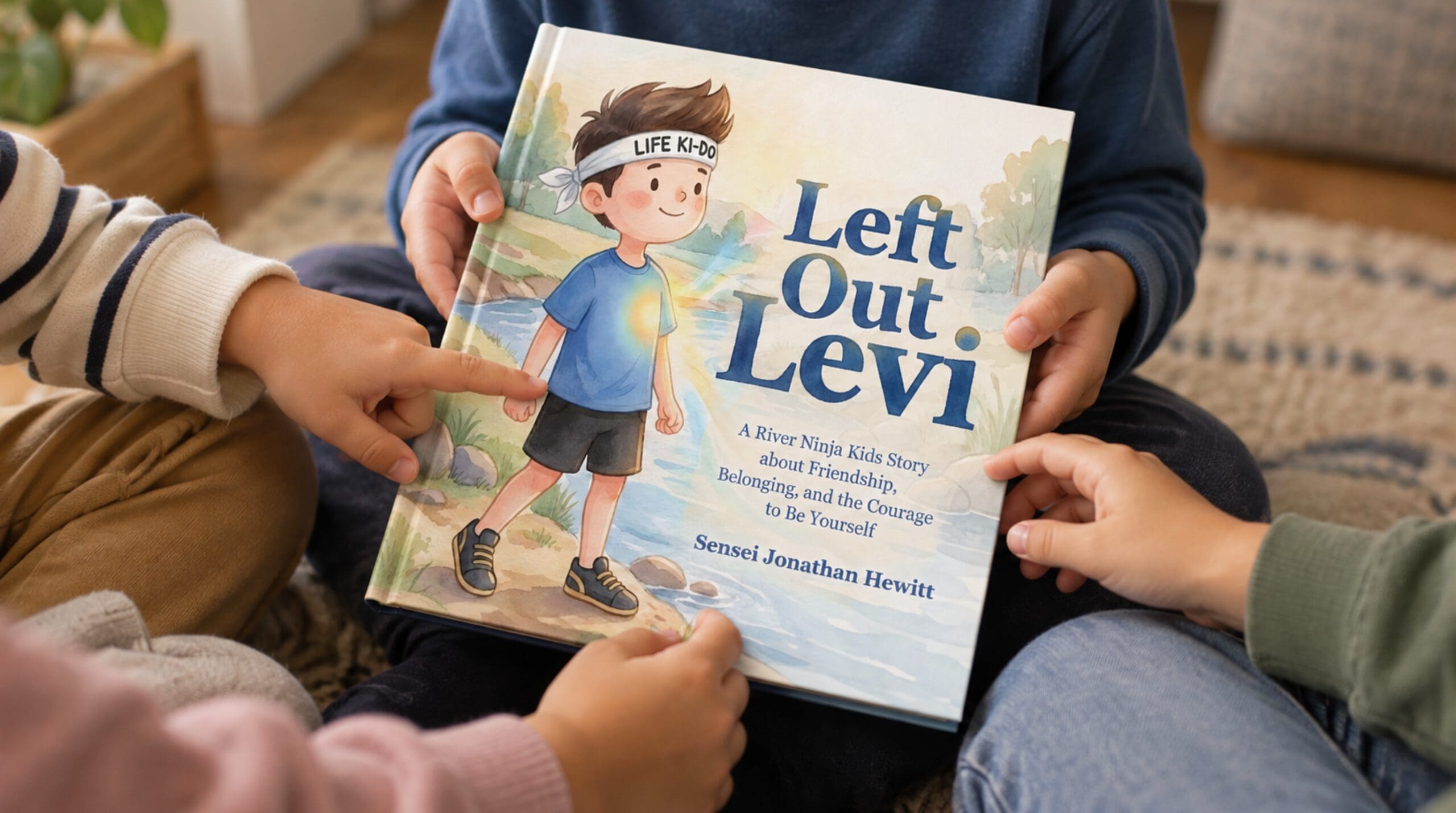
Relationship skills are not only developed through direct practice. For children and young people, stories can be one of the most accessible ways to begin understanding what other people experience, particularly in the social situations where belonging, exclusion, and empathy intersect.
Understanding what it feels like to be left out, to notice someone on the edges of a group, and to consider what another person might be going through, builds exactly the kind of social awareness and empathy that supports healthy relationships from an early age.
Stories can give children a safe way to explore these experiences before they encounter them in their own lives. Explore Left Out Levi, a Life Ki-do story that helps children understand belonging, exclusion, empathy, and the importance of noticing when someone else may need a little connection.
Caring for Your Training Partners
In a healthy martial arts community, advanced students help beginners. Experienced practitioners calibrate their approach to what will actually benefit the person they are working with rather than what will simply demonstrate their own capability. The measure of a good training session is not who dominated but whether both people learned something useful.
This is the Our Shoes orientation applied to a physical practice. The relationship between training partners matters more than who wins any given exchange, and the relationship improves when both people are oriented toward each other’s development as well as their own. That orientation, practiced consistently over time, becomes a deeply ingrained way of approaching other people.
A healthy training environment gives people a place to practice these relationship skills in real time, with different ages, personalities, and experience levels. Explore Life Ki-do’s martial arts programs for adults and children to see how training can become a practical environment for developing cooperation, empathy, and healthier relationships.
Healthy Relationships Start With You
The most important relationships in your life will not become healthier because you finally figure out the right strategy for managing the other people in them. They will become healthier as you develop a clearer, more honest relationship with yourself, and bring that clarity, that presence, and that genuine care into the room with you.
This is not a small undertaking. The patterns formed by fear, insecurity, and unexamined reactivity are often deeply established and genuinely difficult to see clearly. Working to notice them, care for the inner world that contains them rather than suppressing or denying them, and gradually developing a more grounded relationship with your own experience takes real time and patience.
The direction of this work is one of the most valuable any person can take. Not because it will make you perfect, and not because it will guarantee that every relationship becomes easy. But because it changes the quality of what you bring. And what you bring is the one part of every relationship you actually have direct influence over.

Healthy relationships require two people who are willing to participate in the health of the relationship. Self-awareness gives you the foundation to be fully one of those people.
If you want to explore these ideas more practically and develop the skills that support how you show up in your relationships and everyday life, Life Ki-do’s personal development resources offer a place to continue that work.
🗲 JOIN US TODAY!
For families in Austin, Life Ki-do offers a free introductory class for new students of every age and experience level. No prior experience is required, and no commitment is expected. Come and experience the difference that a genuinely nurturing and empowering training environment makes.
Frequently Asked Questions
What makes a relationship healthy?
Healthy relationships depend on mutual respect, honest communication, emotional awareness, clear limits, trust, and a shared willingness to work through difficulty. They are not characterized by the absence of conflict but by the ability to navigate conflict and return to genuine connection afterward. Qualities like curiosity, accountability, and the capacity to repair after rupture tend to be more important in the long run than intensity or chemistry.
Why do healthy relationships start with yourself?
Because your internal state shapes how you interpret and respond to other people. When fear, insecurity, and unexamined reactivity operate outside your awareness, they show up as patterns in your relationships: interpreting ambiguity negatively, seeking from others what can only come from within yourself, and reacting from an activated emotional state rather than responding from a settled one. Developing greater self-awareness does not remove all relational difficulty, but it changes the quality of what you bring to every connection.
How can I become more self-aware in relationships?
Developing self-awareness in relationships involves cultivating the habit of noticing your own inner experience, particularly in moments when you are with other people or navigating relational difficulty. Useful starting points include noticing what you are actually feeling, what you are assuming, what you might be afraid of, what you actually need, and whether you are responding from a considered place or reacting from activation. These are orientations that, practiced consistently, become more natural over time.
What is the difference between empathy and losing yourself?
Empathy means making a genuine effort to understand what another person might be experiencing, without assuming you know exactly what they feel. Losing yourself happens when understanding someone else’s experience means abandoning your own: absorbing their emotional state, setting aside your needs entirely, or forgetting where they end and you begin. The balance between the two requires a stable inner center from which you can be genuinely present with another person without being destabilized by what they are experiencing.
What is the My Shoes, Your Shoes, Our Shoes framework?
My Shoes, Your Shoes, Our Shoes is a Life Ki-do framework for approaching relationships and relational difficulty. My Shoes involves honest self-examination: noticing what you are feeling and communicating authentically from your own experience. Your Shoes involves genuine curiosity about and care for the other person’s experience: listening, trying to understand, and staying open to being surprised. Our Shoes involves collaboration: looking together for what works for the relationship, rather than what vindicates your individual position.
How can I communicate better in relationships?
Clearer communication in relationships tends to begin with clearer self-knowledge: knowing what you actually feel and need before you try to express it. Speaking from your own experience rather than from accusations or assumptions tends to produce less defensive responses. Listening to understand rather than listening to respond changes the quality of what the other person feels able to share. Stating limits clearly and without hostility communicates what you need in a way that can actually be heard.
Does self-improvement fix relationship problems?
Not automatically, and not in every situation. Healthy relationships require mutual willingness from both people. Self-awareness and personal development change what you bring to a relationship, but they cannot substitute for compatibility, mutual respect, or the other person’s willingness to participate in the health of the connection. They also do not mean you should tolerate harmful behavior in the name of self-improvement. What they do change is the quality of foundation you bring, which creates better conditions for healthy relationships to develop where the other elements are also present.
How does martial arts help with relationship skills?
Martial arts training, in a well-run school, provides repeated practice in the relational skills that healthy connections require. Working with partners of different sizes, personalities, experience levels, and emotional states develops the capacity to read, adapt to, and genuinely care for a wide range of people. Communication about needs and limits, practiced explicitly in partner training, develops the same skills needed in any relationship. The orientation toward the other person’s development as well as your own, which characterizes good training, builds an other-regarding awareness that transfers well beyond the training environment.

About Jonathan Hewitt
Jonathan Hewitt is the founder of Life Ki-do Martial Arts & Personal Development and an award-winning author of multiple books on parenting, confidence, and emotional development. For over 30 years, he has helped children, teens, and families build calm strength, confidence, and real-life skills from the inside out. Jonathan is also the host of the Spiritual Ninja Podcast on all platforms.

Why Do I Keep Checking My Phone? What Your Body Has to Do With It
Why do you keep reaching for your phone, even when you do not need it? Explore what you may really be looking for, why fighting the urge rarely works, and how breathing, movement, time outside, and real connection can help you build a healthier relationship with your phone.

Is Martial Arts Safe? What Parents and Adults Should Look for in a School
Is martial arts safe? The honest answer depends on how people teach and train. Learn how awareness, progression, training partners, and school culture shape martial arts safety, plus a practical checklist for visiting a school for yourself or your child.

Why You’re Bad at Things Before You Get Good at Them: How to Learn Without Giving Up
Being bad at something new is not evidence that you should quit. It is evidence that you are at the stage where competence gets built — which means you are exactly where you need to be. This comprehensive guide explores why the pressure to be good immediately actually interferes with learning, what really happens during skill development, and three practical Life Ki-do frameworks — the Three B’s, River Flow, and the A-B Formula — for moving through the beginner stage with more openness, less frustration, and a healthier relationship with the learning process itself.

Healthy Relationships Start With You: How to Build Better Connections
Most people approach relationship problems by asking what the other person needs to do differently. This article takes a different starting point. Understanding how you show up — your fears, assumptions, reactivity, and needs — is the foundation from which genuine connection becomes possible. This guide explores what makes relationships healthy, why your inner world shapes your outer connections, the Life Ki-do My Shoes, Your Shoes, Our Shoes framework, empathy without losing yourself, and how martial arts develops real relationship skills through consistent partner practice.
Ground Fighting in Brazilian Jiu Jitsu: Why It Is Essential
Many physical confrontations can move to the ground, which is one reason ground fighting in Brazilian Jiu Jitsu is such an important skill for martial
Understanding Tai Chi Breathing Techniques for Relaxation and Focus
“The breath is the bridge which connects life to consciousness.” Thich Nhat Hanh wrote those words, and they speak directly to what Tai Chi has


